Clef-Flash is the 9B member of Cloudflare's Clef family. It is small enough for a desktop or laptop, so we tested it on more hardware than the other models: a desktop CPU and four GPUs. If decision models are new to you, start here.
The original
Cloudflare released Clef-Flash alongside the 27B Clef on 1 October 2026, under Apache 2.0 (Cloudflare blog). It is post-trained from Qwen3.5-9B and works the same way as its larger sibling: it reads text or images once and returns a probability for every allowed answer, using the request format TypeSafe introduced with Jev.
Cloudflare describes Clef as the precision model and Clef-Flash as the one for decisions where response time matters. On the Decision Index results Cloudflare published, Clef-Flash scores close to Clef on many tasks, and above it on some, such as WinoGrande and the home appliance simulator (original model card).
What we made
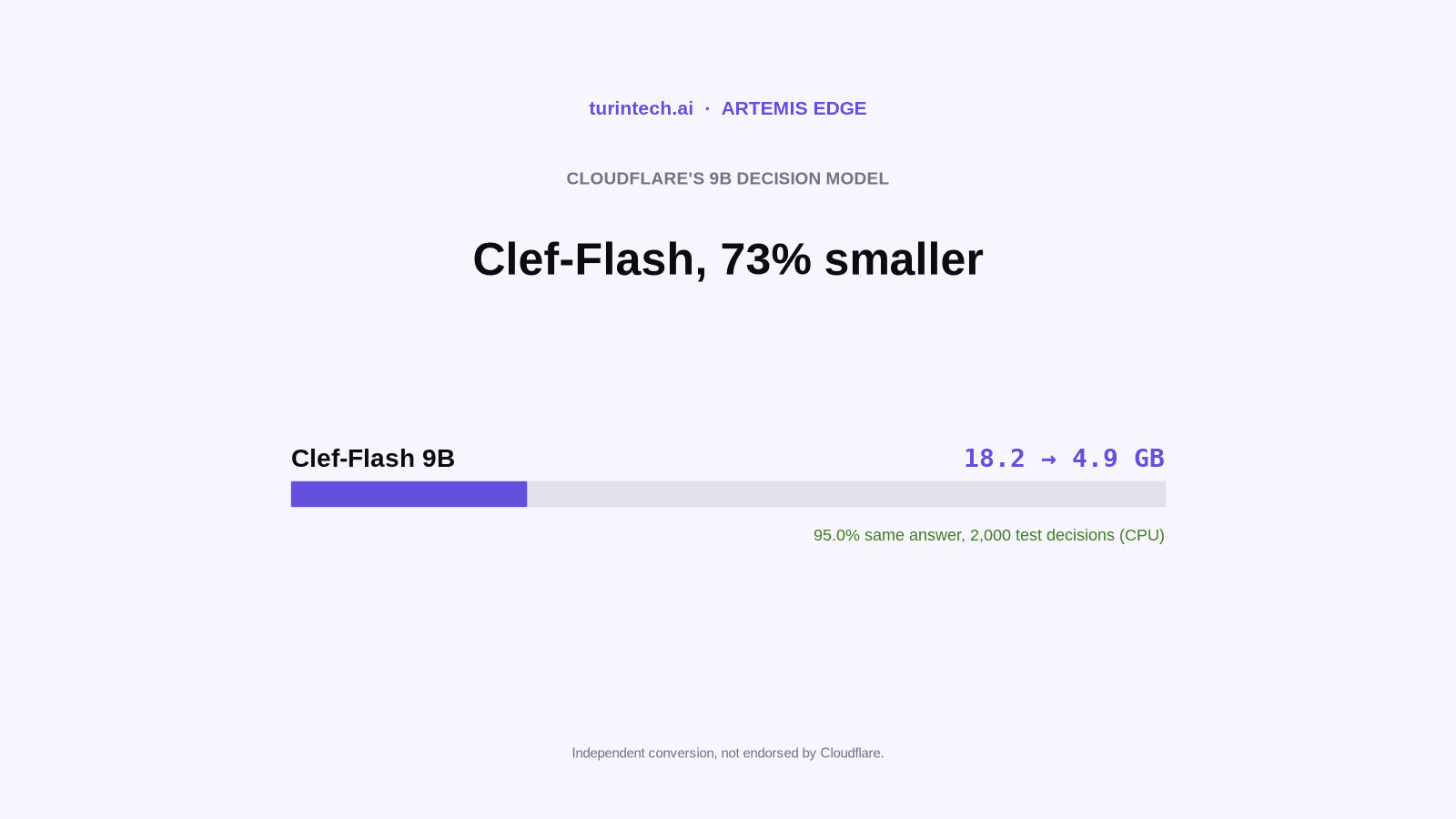
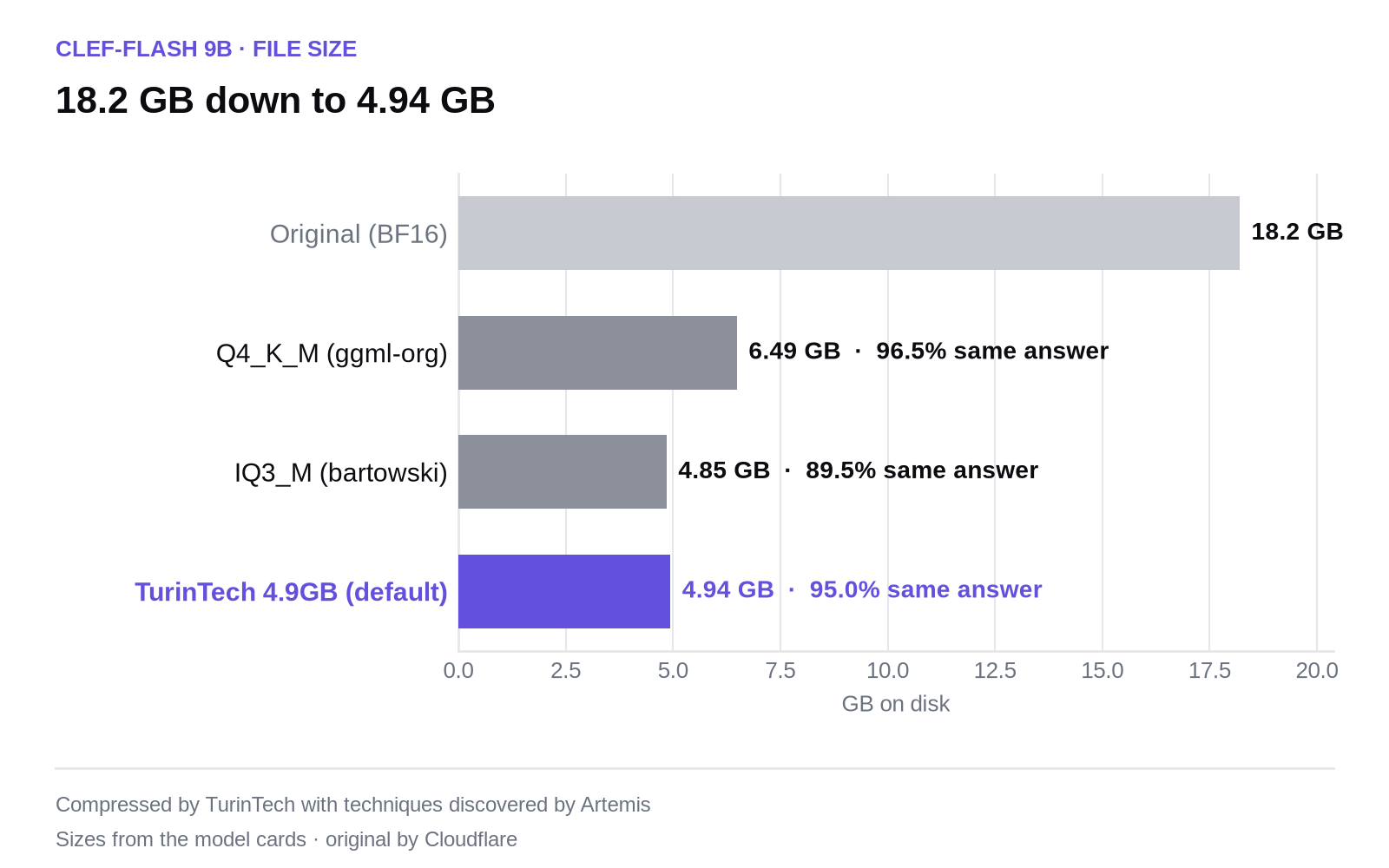
The Clef-Flash Artemis GGUF repository has four files from 3.6 GB to 4.9 GB. The default, Clef-Flash-Artemis-4.9GB.gguf, is 4.94 GB, 73% smaller than the original's 18.2 GB.
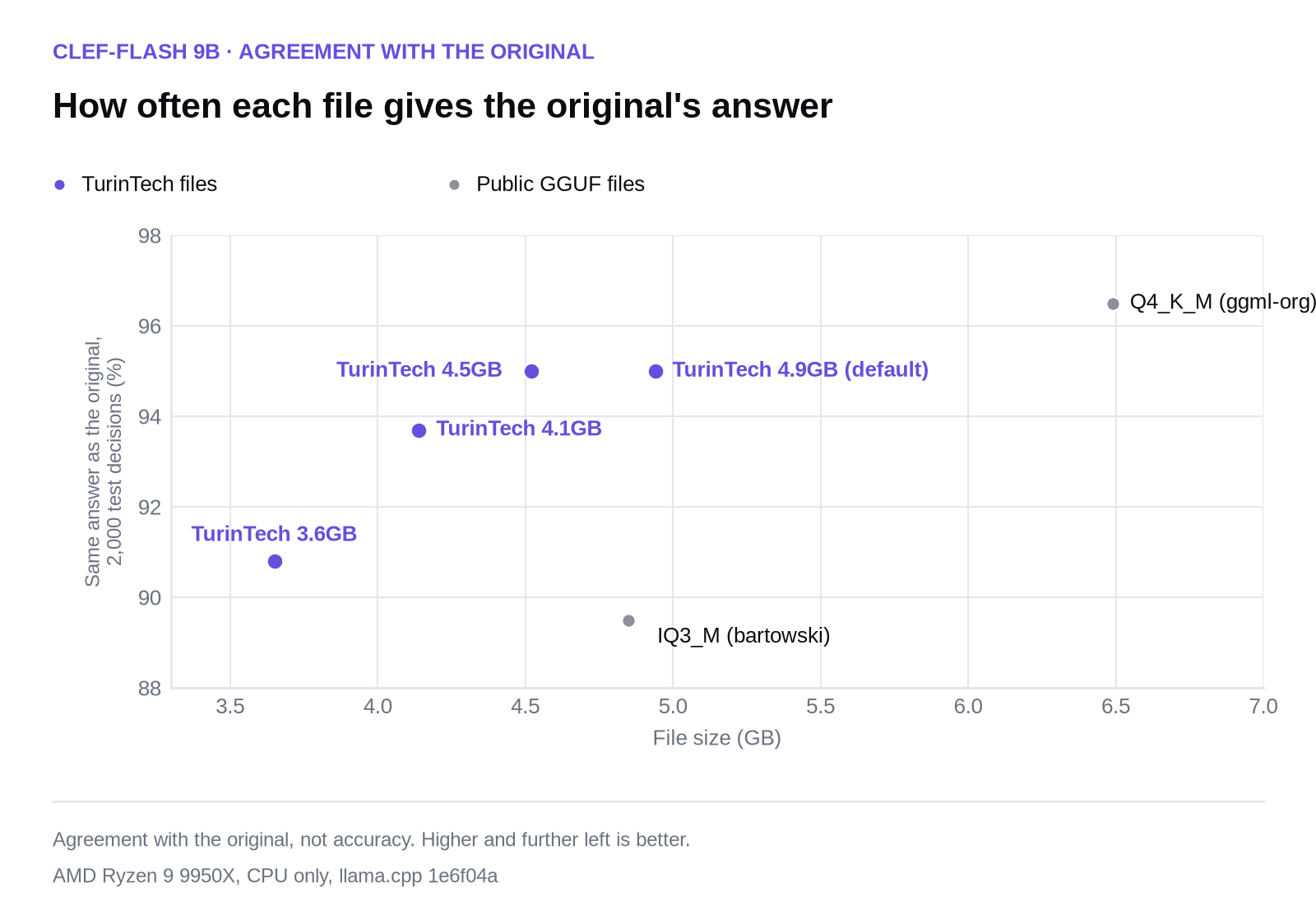
On CPU (an AMD Ryzen 9 9950X), the default gives the original's answer on 95.0% of the 2,000 test decisions, with accuracy 0.1 points lower (70.4% against 70.5%). It did not change any answer the original was more than 80% sure of, on any machine we tested. On 330 image questions, run on an NVIDIA A100, it agrees 97.6% of the time. On that A100 it needs 5.5 GiB of GPU memory, against 16.5 GiB for the original.
| File | Size | Same answer as the original (CPU) | Accuracy change (points) | Confident answers changed |
|---|---|---|---|---|
| Original, BF16 | 18.2 GB | reference | reference | |
Clef-Flash-Artemis-4.9GB (default) | 4.94 GB | 95.0% | -0.1 | 0 |
Clef-Flash-Artemis-4.5GB | 4.52 GB | 95.0% | -0.8 | 0 |
Clef-Flash-Artemis-4.1GB | 4.14 GB | 93.7% | -1.4 | 0 |
Clef-Flash-Artemis-3.6GB | 3.65 GB | 90.8% | -1.7 | 0 |
A real run, recorded live on a desktop CPU (AMD Ryzen 9 9950X). The original and Clef-Flash-Artemis-4.9GB.gguf, each with the same BF16 vision projector, get the same synthetic invoice images and order details and make the same call on all three. On the price mismatch both choose review, at 91.6% and 89.1%.
How it compares with public files
The ggml-org Q4_K_M, at 6.49 GB, is a little closer to the original than our default: it agrees on 96.5% of the test decisions on CPU, with accuracy 0.3 points higher. Our default is 1.55 GB smaller.
At the small end, bartowski's IQ3_M (4.85 GB) agrees 89.5% of the time with accuracy 2.0 points lower. Our 3.6 GB file is 1.2 GB smaller and closer to the original on the test decisions (90.8%) and on the held-out ones (92.4% against 91.4%). The IQ3_M is closer on the benchmark sample (94.3% against 90.7%).
The same file on other hardware
The same files were run on four GPUs with all layers on the GPU: an NVIDIA A100 80 GB, an RTX 5090, a GB10 (the chip in DGX Spark) and an RTX 3060 12 GB. The one exception is the original on the RTX 3060: it does not fit in 12 GB and ran partly on the CPU, while our 4.9 GB file runs fully on the card.
| File | A100 | RTX 5090 | GB10 | RTX 3060 |
|---|---|---|---|---|
Clef-Flash-Artemis-4.9GB | 94.1% | 94.2% | 94.2% | 94.2% |
Clef-Flash-Artemis-3.6GB | 91.0% | 91.0% | 91.1% | 91.0% |
| Public Q4_K_M (ggml-org) | 96.3% | 96.0% | 96.1% | 96.5% |
| Public IQ3_M (bartowski) | 89.5% | 89.7% | 89.8% |
Share of the 2,000 test decisions on which each file gives the original's answer. A blank cell was not run on that machine.
The GPUs agree with each other to within a few tenths of a point. On GPU the default sits about one point further from the original than on CPU (94.1 to 94.2% against 95.0%), and the public Q4_K_M files move by less. No file changed a confident answer on any GPU.
Where it is weaker
Questions with 10 or more options are harder for every compressed file, and our smaller files find them harder than most: the 3.6 GB file gives the original's answer on 83.7% of them, against 95.3% for the public Q4_K_M. For workloads with long option lists, a larger file is the safer choice, checked on real questions first.
Shuffling the answer options changed no answers for any file, and repeat runs were identical. Clef-Flash answers all the questions in a request together; sending them one per request changes 8.2% of the original's own answers, so any comparison needs the same request shape on both sides.
Run it
The files run on stock llama.cpp from 9 October 2026 or newer.
hf download turintech/Clef-Flash-Artemis-GGUF Clef-Flash-Artemis-4.9GB.gguf --local-dir .
llama-server -m Clef-Flash-Artemis-4.9GB.gguf --port 8080 -c 16384 -ub 4096 -b 4096
Keep -ub 4096 -b 4096, since at the default of 512 the /v1/systemone endpoint rejects longer inputs. For images, add the vision projector from ggml-org/Clef-Flash-GGUF. The model card has the full test table, the setup for each machine and checksums.
This is an independent conversion, not affiliated with or endorsed by Cloudflare, and the credit for Clef-Flash belongs to Cloudflare. The files were compressed by TurinTech with techniques discovered by Artemis. The rest of the Artemis Edge collection is on Hugging Face. For a version tuned on your own decisions or built for your hardware, book a call.